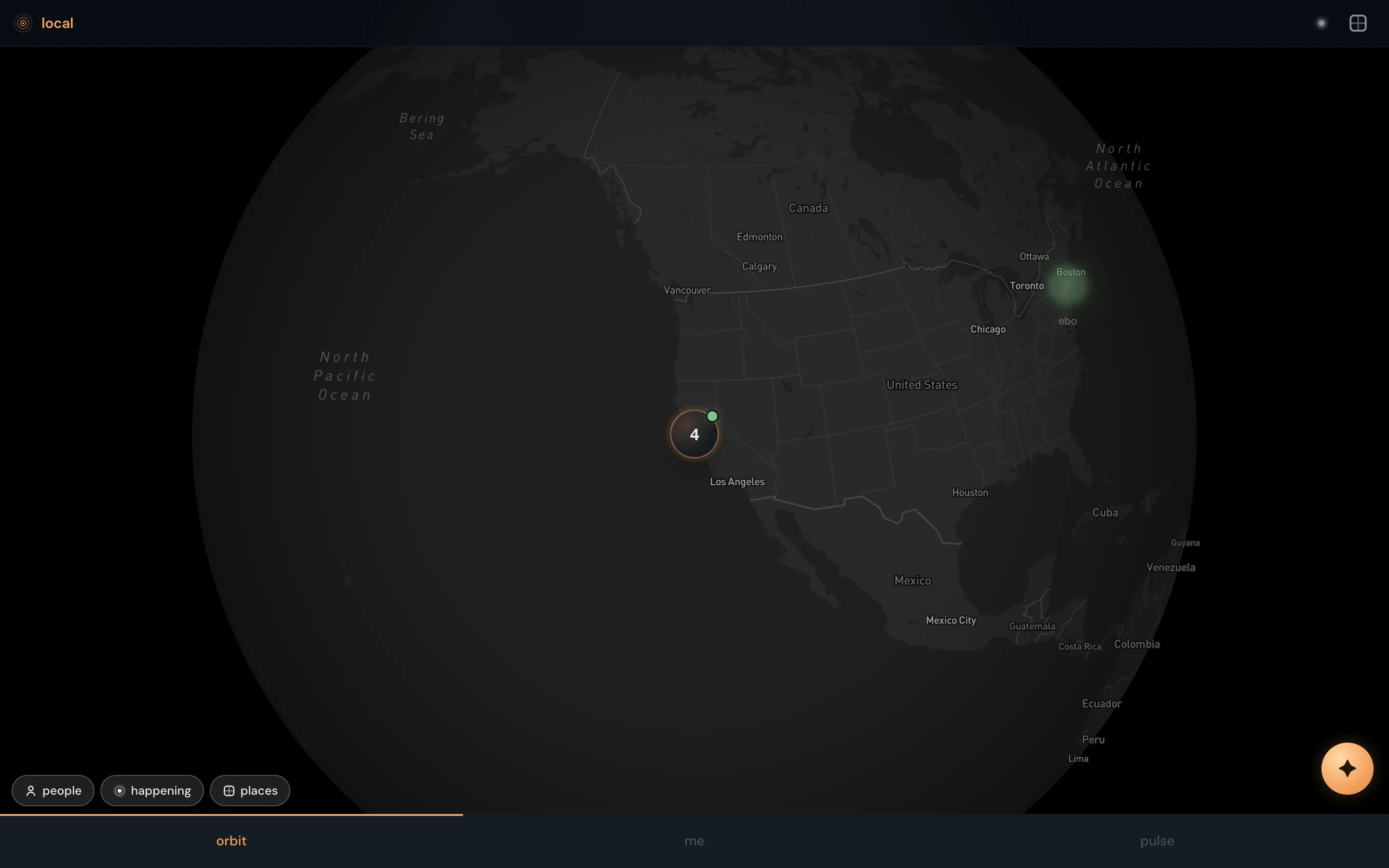
When I lived alone in Reno, I realized I could disappear and nobody would notice for a while. SameOrbit started there. The smallest social contract there is, “I noticed you exist,” needed somewhere to live.
It’s a private map for communities that already exist in real life, like a Burning Man camp or a group of friends spread across three time zones. You join once and you get everyone in it. Each person picks how precisely they show up: an exact spot, a city, a country, or nowhere at all. When you want to reach someone, you tap them and the app hands you off to whatever messenger they already use.
When orbits cross
“I’ll be in Lisbon next month” might be the most useful thing anyone tells the app. Everyone’s week sits on the map, so when your plans cross a friend’s, a small warm light comes on. Nothing pings you. You notice it the next time you look, the way you’d notice a neighbor’s porch light.
Kit only shares a country, so Kit shows up as a soft region and any crossing stays country level. Sharing less is a real choice in SameOrbit, and the map has to respect it everywhere.
Quiet on purpose
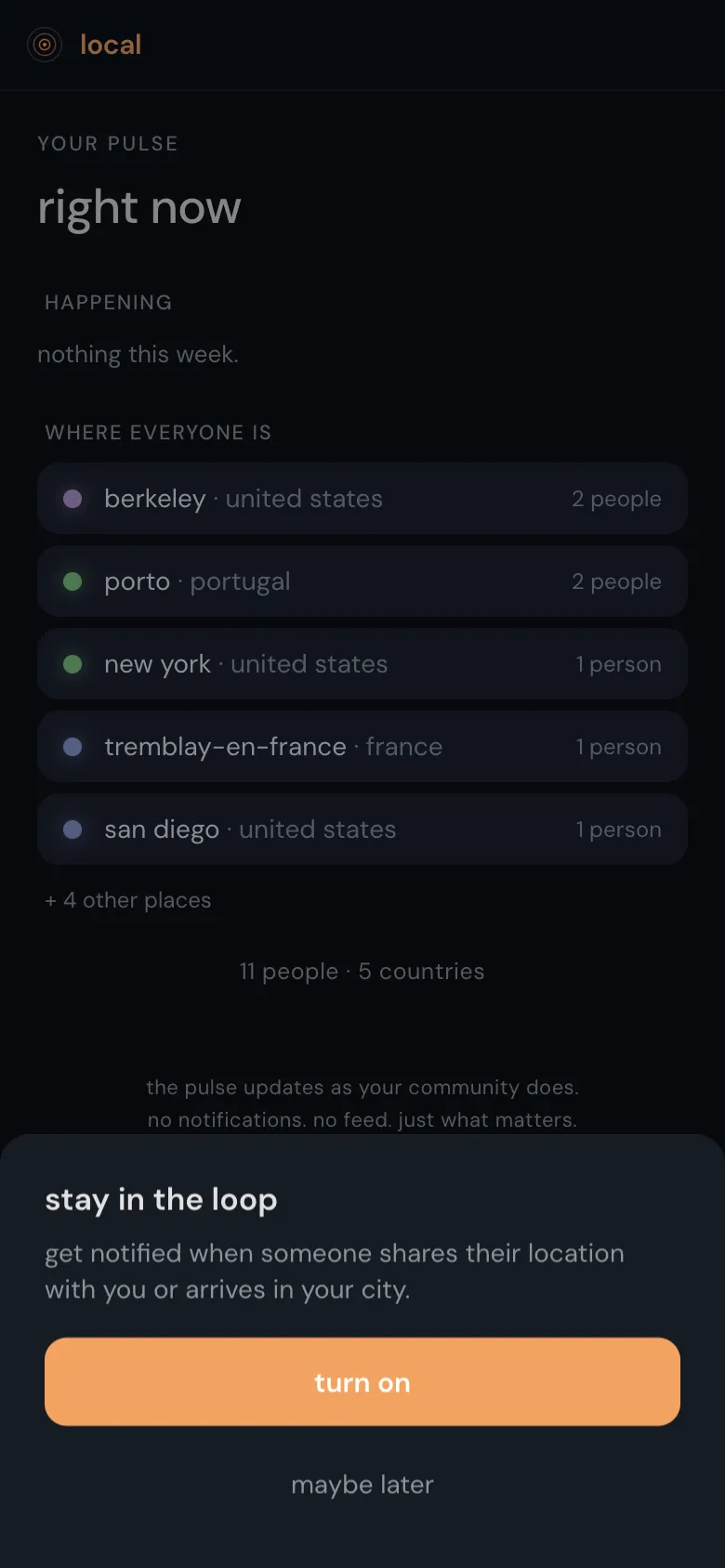
The whole design brief fits in two words: quiet gravity. The palette is the hour after sunset, with one warm accent meant to feel like spotting a lit window across a valley. If a screen has more than two of those lights, something’s wrong. There are no streaks or red badges, and every screen should feel fine to close. If you close the app wanting to text someone, it worked.
Two clients, one server
The web app is a Framework7 PWA, and it’s where features land first. A Flutter app stays at parity through deliberate sync passes, and both clients pin their tests to shared fixtures so they can’t quietly drift apart. It’s in alpha with two real communities. The native launch is the experiment that decides whether ambient actually works or only looks like it does.